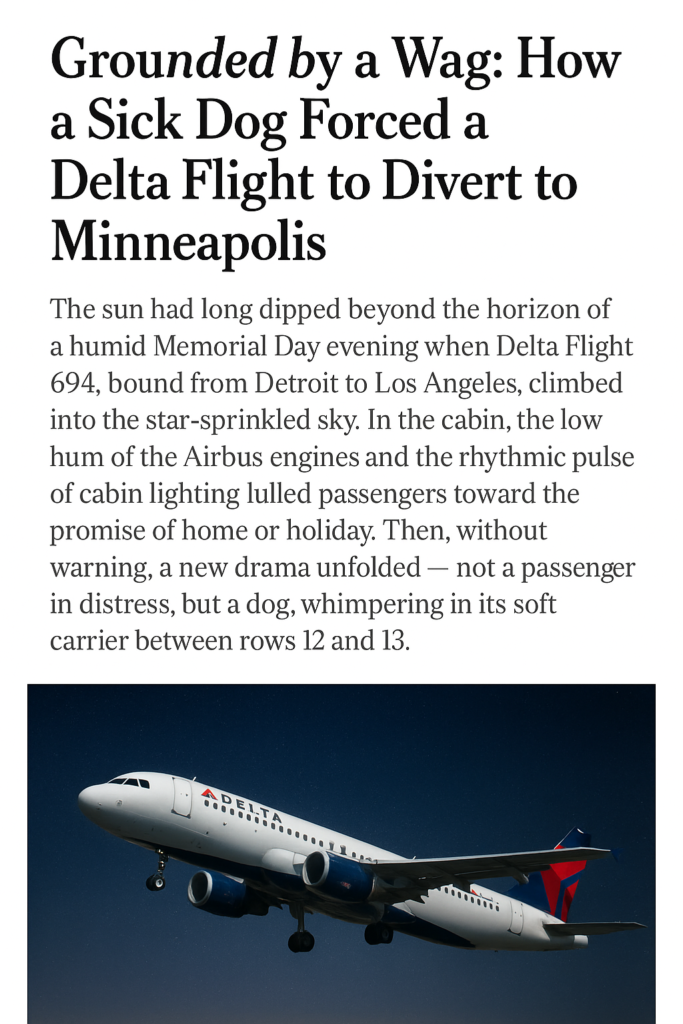
The delta flight dog diversion MSP incident began as a routine evening departure but quickly turned into a powerful reminder that modern air travel is no longer just about schedules and destinations—it is also about compassion, responsibility, and the lives we choose to protect at 35,000 feet. The sun had long dipped beyond the horizon of a humid Memorial Day evening when Delta Flight 694, bound from Detroit to Los Angeles, climbed into the star-sprinkled sky. In the cabin, the low hum of the Airbus’ engines and the rhythmic pulse of cabin lighting lulled passengers toward the promise of home or holiday. Then, without warning, a new drama unfolded — not a passenger in distress, but a dog, whimpering in its soft carrier between rows 12 and 13.
In that moment, aboard that aircraft slicing through darkness, the familiar priorities of flight — speed, schedule, destination — faced an unexpected test. What should have been routine became extraordinary when the captain, after consulting crew and an onboard veterinarian, made the unusual decision to turn south toward Minneapolis–Saint Paul International Airport (MSP) — Delta’s bustling Upper Midwest hub — and land midway through the journey so that the ailing dog could receive urgent care.Live and Let’s Fly+1
Here in this junction between wind and runway, where steel birds rest and roar, the world paused to reflect on how one of humanity’s oldest companions reshaped the arc of modern travel. This is the story of that diversion — and what it reveals about the evolving culture of air travel, pet companionship, and human priorities.
Origins: The Rise of Pets in Flight
Pets, particularly dogs, have long traversed the globe in the care of humans. Historically, though, crossing oceans and continents was a venture reserved for cargo holds and ocean liners. Only in the latter half of the 20th century did commercial airplanes begin accommodating animals in cabins, a shift fueled by rising leisure travel and the emotional bond between owners and their animals.
By the early 2000s, airlines like Delta Air Lines had formalized pet-in-cabin policies — allowing small dogs and cats to fly under seats in specially designed carriers. ti-inc.org
In tandem, the airline industry started codifying rules for service and emotional support animals, a separate category defined by federal regulations that once allowed certain dogs to fly free of charge and outside carriers if trained to assist passengers. Those categories have since seen regulatory tightening because of safety concerns and misuse. Delta Professional
Today, whether it is a Chihuahua nestled against a traveler’s boots or an anxiety-soothing lap dog on a transcontinental flight, animals in cabins have become a normalized — and often emotionally charged — element of air travel.
The Moment: Flight 694 Diverts to MSP
On May 26, 2025, roughly sixty minutes into its journey from Detroit to Los Angeles, Flight 694’s calm ascent through the night was interrupted by something entirely unanticipated: a cabin pet falling seriously ill. After attendants alerted the cockpit, the captain contacted dispatch and opted to divert the flight to MSP Airport, where medical professionals awaited the aircraft on the ground. Live and Let’s Fly
This unscheduled landing, arriving at 9:51 p.m. local time, caused a ripple through MSP’s evening operations, delaying 181 passengers and six crew members by approximately 2.5 hours before the flight resumed westward. Live and Let’s Fly
This was not an isolated internet rumor — numerous aviation outlets and regional reporting confirmed the unusual diversion. Los Angeles Times
Modern Significance: Pets, Expectations, and Airline Policy
The diversion sparked widespread public conversation: Was landing an entire jet for a dog justified? Was this an act of compassion or operational overreach? These questions speak to deeper shifts in how society values animal life and how airlines balance these values with safety and economics.
Delta’s official position emphasized safety — for all onboard. In its statement, the airline declared that “the safety of our customers and people comes before everything else,” highlighting that this duty of care extends to cabin pets. Live and Let’s Fly
This moment also collides with Delta’s evolving pet policies in 2025, which continue to restrict in-cabin and cargo pet travel, tighten documentation requirements, and limit pet entries due to safety and practicality concerns. Travel Agent Central+1
Where It Matters: MSP — A Hub of Movement and Meaning
Minneapolis–St. Paul International Airport (MSP) isn’t just the site of the diversion; it’s a vital crossroads in American aviation. Positioned between Canada’s border and the Rocky Mountains, MSP serves as one of Delta’s primary hubs, handling hundreds of flights daily and connecting communities from Duluth to Dubai. Metropolitan Airports Commission
For passengers arriving unexpectedly — dogs and humans alike — MSP offers pet relief areas across terminals and partnerships with local boarding facilities, underscoring the airport’s adaptation to animal-inclusive travel. Mpls.St.Paul Magazine
Table 1 – Popular Airport Pet Travel Signatures
| Airport / Hub | Defining Features | Experience Type |
| MSP (Minneapolis–St. Paul) | Multiple indoor/outdoor pet relief areas; pet boarding services | Calm, pet-friendly connection hub |
| LAX (Los Angeles International) | High domestic pet traffic; stringent carrier checks | Busy, procedure-intensive |
| JFK (New York John F. Kennedy) | Service animal screening focus; long-haul prep | Policy-heavy, international gateway |
| ATL (Atlanta Hartsfield-Jackson) | Major international cargo pet travel routes | High volume, diverse pet services |
| ORD (Chicago O’Hare) | Popular Midwest transit point; pet relief zones | Balanced pet logistics |
Styles and Variations: How Animals Fly Today
Air travel now grapples with various styles of animal transport:
- In-cabin pets: Required to stay in FAA-approved carriers under seats — the most common form. ti-inc.org
- Delta Cargo provisions: For pets too large for cabins, cargo travel offers temperature-controlled kennels but with stricter timing. Travel Agent Central
- Service animals: Trained and documented; allowed in cabin floor space. Delta Professional
- Emotional support animals: Now governed by tighter rules to reduce misuse and in-flight incidents. Delta Professional
Cultural and Environmental Impact: Paws Across the Sky
The image of an airliner diverting for a dog reflects broader cultural shifts: pets are family, travel is inclusive, and technology meets empathy. Anthropologists describe this as part of the “human-animal life course,” where emotional bonds shape travel norms and commercial policy alike.
But environmental and operational costs loom large. Diversions exact fuel, scheduling disruptions, and ground-crew reallocations. Critics argue that compassion must be balanced with system integrity, while supporters see this as an evolution in humane travel.
Expert Insight: Q&A at MSP Terminal 1
On a cool evening at the Delta gate lounge near MSP’s central concourse, I met Avi Reynolds, a seasoned Delta operations manager. The air smelled of coffee, jet fuel, and idle anticipation.
Q1: What factors led the captain to divert Flight 694 to MSP?
A: “When the onboard veterinarian assessed the dog’s condition and recommended care that couldn’t wait until LAX, the captain chose to land at the nearest large hub with full medical services — MSP. These decisions always prioritize safety.” Live and Let’s Fly
Q2: How often do animal-related diversions occur?
A: “Rarely — perhaps once every few years industry-wide. Most situations are manageable in-flight. But this one met thresholds that triggered diversion protocols.”
Q3: Do such events change airline policy?
A: “They spark discussions. We constantly review pet procedures and cabin safety with FAA guidelines.”
Q4: How does MSP support pets and passengers?
A: “MSP has dedicated relief areas, partnerships with pet services, and trained support staff to assist any traveler with a service animal or cabin pet.” Mpls.St.Paul Magazine
Q5: What’s the key lesson for travelers?
A: “Plan, document, and be ready. But also understand that compassion and safety coexist up here — miles above ground.”
Practical Preparation: How to Travel with Pets Responsibly
- Book early: Limited in-cabin pet slots fill fast. Metropolitan St. Louis Sewer District
- Documentation: Health certificates and vaccination records streamline boarding. Metropolitan St. Louis Sewer District
- Carrier compliance: Ensure size fits under the seat and meets airline specs. BringFido
- Relaxation tools: Familiar toys or pheromone sprays can reduce stress.
- Relief stops: Be aware of MSP’s pet relief areas before security and post-screening. Mpls.St.Paul Magazine
FAQs
Q: Why did Flight 694 divert to MSP?
A: Due to a dog falling seriously ill onboard; the captain chose the nearest major airport with medical support. Live and Let’s Fly
Q: Are pets allowed in cabins on Delta?
A: Yes, small dogs and cats may fly in carriers under seats, following strict policy rules. ti-inc.org
Q: What documentation do I need for pets?
A: Health certificates and proof of vaccinations are often required, especially for service animals. Metropolitan St. Louis Sewer District
Q: Does Delta still allow emotional support animals?
A: Policies have tightened; now only trained service animals with proper documentation are accepted without carrier restrictions. Delta Professional
Q: How can I care for my dog during long flights?
A: Frequent hydration before boarding, comfortable carriers, and leveraging airport relief areas like those at MSP help manage stress. Mpls.St.Paul Magazine
Takeaways: Between Compassion and Commerce
Flight 694’s diversion reminds us that travel isn’t just logistics — it’s a tapestry of stories, relationships, and unexpected choices. Pets embody the human need for connection, and airlines are learning to navigate that landscape with care, policy, and sometimes, unscheduled landings.
Conclusion: The Human Heart in Aviation’s Flight Path
As aircraft streak across blue horizons, carrying hopes, frustrations, laughter, and sometimes paws in carriers, a deeper truth emerges: travel is a reflection of human values. Technologies evolve, routes shift, and airports expand, but the reasons we travel — connection, love, reunion — remain constant.
When a dog’s illness reshaped a flight path, it was not just a quirky news moment — it was a reminder that empathy takes flight in the same airspace as engine thrust and regulatory charts.
Whether you are a frequent flier or a first-time traveler, that tale from the sky invites us all to consider how compassion and practicality will continue to shape the future of flying — one wag at a time.

